An official website of the United States Government
Official websites use .gov
A .gov website belongs to an official government organization in the United States.

A .gov website belongs to an official government organization in the United States.

A lock or https:// means you’ve safely connected to the .gov website. Share sensitive information only on official, secure websites
 |
It may be a chemical incident if you see:
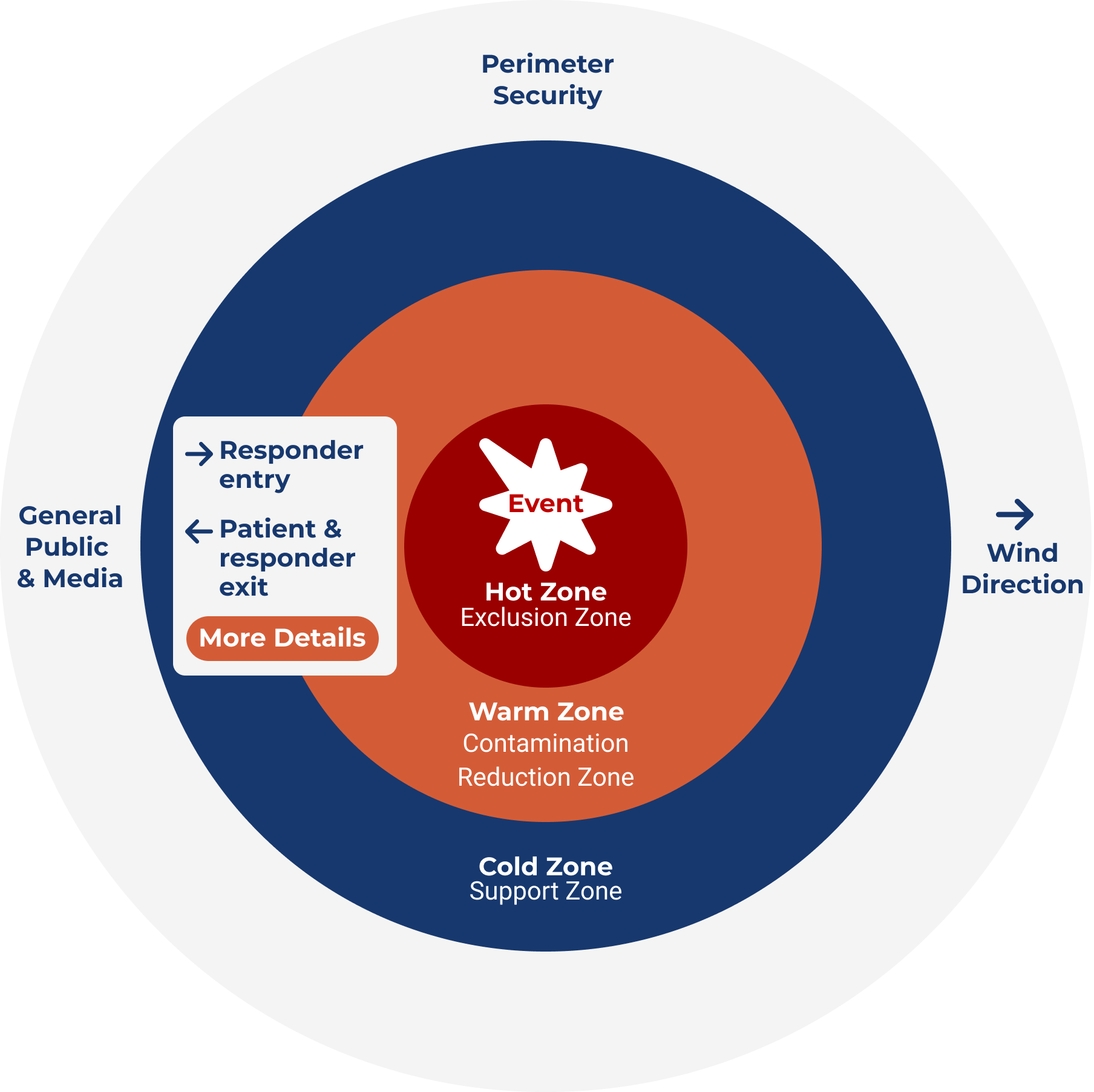
Information about contaminated, clean, and transition areas at a chemical incident scene
Large scale view of Hazard Control Zones showing wide coverage of the three zones.
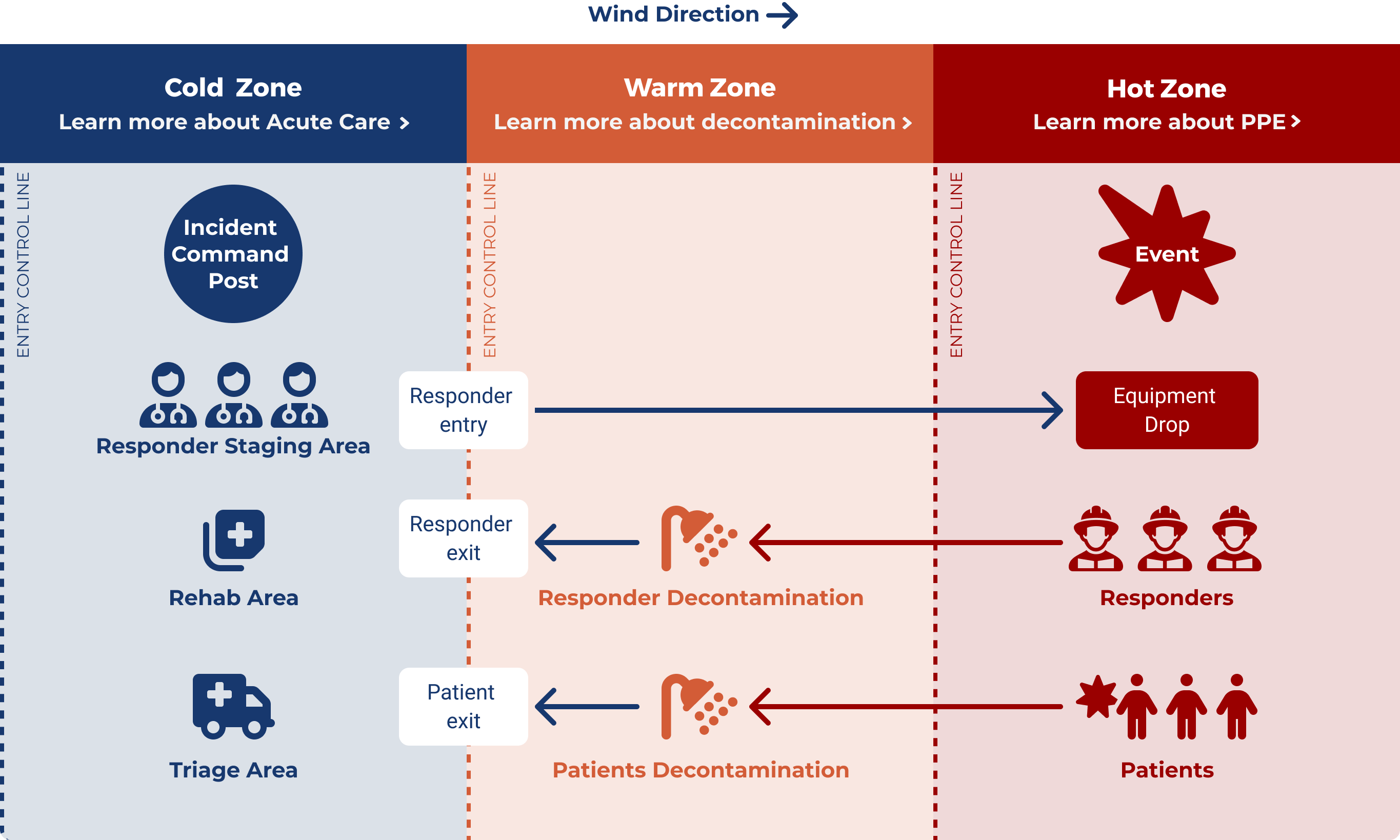
Close view of entry and egress lanes through the Hazard Control Zones, along with major functions in each zone.
Resources for decision-making to protect the general public and responders.
Evacuation vs. Shelter-in-Place decisions are influenced by many factors and should rely on the professional judgement of the Incident Command Staff
| Evacuation | Shelter-in-Place |
|---|---|
| Flammable vapors | Dangerous exposure likely during evacuation |
| Leaky buildings | Closed, non-leaky building |
| Continuous source of vapors; vapors close to ground and persistent | Rising vapors that will quickly disperse |
| All potentially exposed people outdoors | For personnel already indoors |
| Few potentially exposed people and sufficient resources to evacuate them | Too many people to evacuate given existing resources |
| Stable, predictable, long-lasting hazard | Rapidly changing circumstances for a safe evacuation |
Resources and tools for determining downwind hazard distances and defining hazard areas.
The infographic illustrates the standard layout and flow of operations within emergency response zones during a hazardous materials or contamination incident. It depicts three areas—Cold Zone, Warm Zone, and Hot Zone—each with defined functions and movement pathways for responders and patients.
Cold Zone: This is the safe operational area where command and support functions occur. It includes the Incident Command Post, Responder Staging Area, Rehab Area, and Triage Area. Personnel and patients exit into this zone only after completing decontamination procedures.
Warm Zone: The Warm Zone serves as the designated decontamination corridor. It contains separate processes for responder and patient decontamination, with clearly marked entry and exit points back into the Cold Zone. Movement pathways show responders and patients transitioning from the Hot Zone into decontamination before re-entering safe areas.
Hot Zone: The Hot Zone represents the area of the hazardous event. It includes the site of the incident, affected individuals, and an equipment drop location. Only properly equipped responders may enter this zone.
Directional arrows illustrate the flow of responders and patients from the Hot Zone through decontamination and into the Cold Zone. The infographic also notes that wind direction plays a role in zone placement and safety considerations.